V6 med turbo kontra V6 med kompressor
Redaktør: Moderatorer
-
fynne
- Medlem
- Indlæg: 120
- Tilmeldt: 27 sep 2004, 18:34
- Geografisk sted: Frederikshavn

-
Yugo Turbo
- Mester Medlem
- Indlæg: 2515
- Tilmeldt: 18 aug 2003, 09:05
- Geografisk sted: Veksø Sjælland
-
guest
hvad så lasse det viser bare hvor meget du kender til historienYugo Turbo skrev:kompressore er for tøsedrenge!!! turbo er gud.
er der nogen der kan nævne bare et professionelt racerteam der kører med kompressor ud over amerikanerbådene? som iøvrigt jo er begyndt at se lyset og sætte en stak turboer på...
i grunden også sjovt at det kun er turbo de har brugt i formel 1, hvis kompressore virker så godt hvorfor har de så ikke brugt dem i f1?
en af de fedeste lyde fra en formel1 stammer fra en 1953 Formula One BRM 1.5 litre V-16 Supercharged
http://www.billzilla.org/BRM-pushstart.mp3
http://www.billzilla.org/BRM-loudpass.mp3
http://www.billzilla.org/BRM-returntopits.mp3
http://www.billzilla.org/BRM-fulltrack.mp3
http://www.billzilla.org/BRM-incar.mp3
forresten en fed side om toyotas 4age
-
guest
her er forresten lidt info om brm'eren
The complex, supercharged V16 was at least orthodox in its layout and the 1947 design target power output of 300 bhp appeared adequate. However, it was not generous, for the simple straight-eight in the Alfa Romeo 158, the car to beat, was rated at 254bhp in 1946 and 300bhp in the 1947 model. There was, however, more development potential in the V16, and it was envisaged that it would be a competitive power unit through to 1953. In the early days it was estimated that by 1953, 600 bhp at 12,000 rpm would be achieved.

The short-stroke, high-revving Vl6 had its cylinder banks at an included angle of 35 degrees, with alloy cylinder heads and block, and tiny cast-iron liners (a weak point, as they broke up when coolant leaked into the cylinders). The engine could be regarded as a pair of 744cc V8s with a common two-piece, 10-bearing crankshaft. There was a half speed power take-off at its centre, with trains of gears operating the twin overhead camshafts. The drive for the supercharger was taken from the front of the output shaft, forward via a gear train.
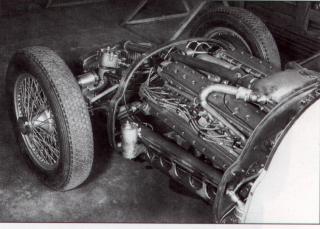
The complex, supercharged V16 was at least orthodox in its layout and the 1947 design target power output of 300 bhp appeared adequate. However, it was not generous, for the simple straight-eight in the Alfa Romeo 158, the car to beat, was rated at 254bhp in 1946 and 300bhp in the 1947 model. There was, however, more development potential in the V16, and it was envisaged that it would be a competitive power unit through to 1953. In the early days it was estimated that by 1953, 600 bhp at 12,000 rpm would be achieved.
The short-stroke, high-revving Vl6 had its cylinder banks at an included angle of 35 degrees, with alloy cylinder heads and block, and tiny cast-iron liners (a weak point, as they broke up when coolant leaked into the cylinders). The engine could be regarded as a pair of 744cc V8s with a common two-piece, 10-bearing crankshaft. There was a half speed power take-off at its centre, with trains of gears operating the twin overhead camshafts. The drive for the supercharger was taken from the front of the output shaft, forward via a gear train.
-
guest
1950-51 BRM V16 Type 15 Mk 1
ENGINE
Type:
135-degree V16, longitudinally mounted ahead of the cockpit; water-cooled, dry sump
Construction:
alloy cylinder block with cast-iron wet liners; light-alloy crankcase with two-piece, 10-bearing crankshaft
Bore x stroke:
49.53 mm x 48.6 mm
Displacement:
1488 cc
Valve gear:
two valves (diameters: inlet 1.25", exhaust 1.09") per cylinder at an included angle of 80 degrees, operated through rocking followers by twin overhead camshafts per bank of cylinders, gear-driven from centre of crankshaft
Fuel system:
Rolls-Royce two-stage centrifugal supercharger, two SU carburettors; petrol/alcohol fuel
Ignition:
Lucas coil with four Lucas magnetos; one Lodge spark plug per cylinder
Maximum power:
330 bhp at 10,250 rpm (1950) to
460 bhp at 1 1,000 rpm (1951)
TRANSMISSION
Type:five-speed manual BRM gearbox, ZF-type limited-slip differential, 7.5-in three-plate clutch
Ratios:
according to circuit
ENGINE
Type:
135-degree V16, longitudinally mounted ahead of the cockpit; water-cooled, dry sump
Construction:
alloy cylinder block with cast-iron wet liners; light-alloy crankcase with two-piece, 10-bearing crankshaft
Bore x stroke:
49.53 mm x 48.6 mm
Displacement:
1488 cc
Valve gear:
two valves (diameters: inlet 1.25", exhaust 1.09") per cylinder at an included angle of 80 degrees, operated through rocking followers by twin overhead camshafts per bank of cylinders, gear-driven from centre of crankshaft
Fuel system:
Rolls-Royce two-stage centrifugal supercharger, two SU carburettors; petrol/alcohol fuel
Ignition:
Lucas coil with four Lucas magnetos; one Lodge spark plug per cylinder
Maximum power:
330 bhp at 10,250 rpm (1950) to
460 bhp at 1 1,000 rpm (1951)
TRANSMISSION
Type:five-speed manual BRM gearbox, ZF-type limited-slip differential, 7.5-in three-plate clutch
Ratios:
according to circuit
-
jens
- Mester Medlem
- Indlæg: 788
- Tilmeldt: 01 jan 1970, 01:00
- Geografisk sted: Vestsjælland
Find en 4 liters cologne v6 fra en ford explorer så kan du køre på blyfri. Med hensyn til syn er der ingen af delene der kan synes mere hvis synsmændene er emsige med at turbo automatisk er over + 20%. Så 4.0 eren er den billigste måde samtidig med at du kommer af med den gamle tikkende oliebrænder og får et dejligt bundtræk + stadig mulighed for at skrue uden at brænde hænderne.